

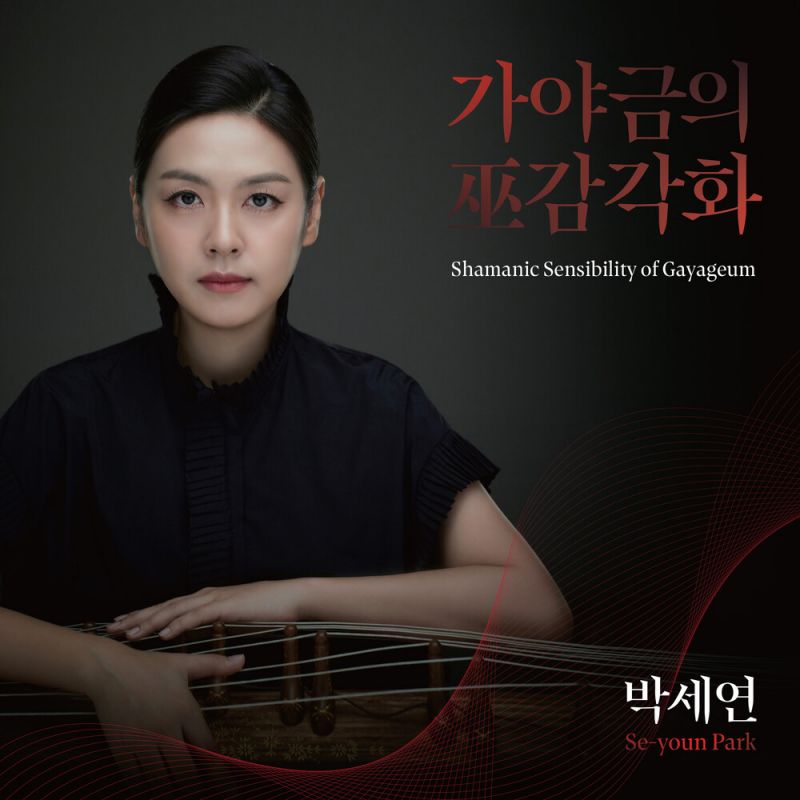
‘가야금의 무감각화’는 전통악기 가야금을 중심으로, 한국 무속음악의 전통과 현대적인 창작의 경계를 넘나드는 실험적인 음악 프로젝트이다. 이 앨범은 가야금 연주자 박세연의 예술적 진정성과 열정, 젊은 작곡가 황재인의 두려움 없는 상상력, 그리고 하와이 출신 작곡가 도널드 워맥의 동양 전통에 대한 섬세한 감수성이 어우러져 완성된 작품들로 구성되어있다. 앨범에 수록된 곡들은 2024년 12월 10일 국립국악원 우면당 무대에서 박세연의 연주로 초연 되었다.
이질적인 세 예술가의 음악적 언어는 ‘巫樂(무악)’이라는 공통의 도가니 안에서 조화를 이루며, 제주칠머리당굿, 동해안별신굿, 남해안별신굿, 진도씻김굿 등 한국 무속의 대표적 음악 요소들을 바탕으로 현대적인 가야금 창작음악으로 새롭게 탄생했다. 이는 단순히 전통의 재현을 넘어, 가야금이라는 악기를 통해 굿의 장단과 정서를 새롭게 해석함으로써 무속음악의 잠재적 에너지와 동시대적 감성을 구현하고자 했다,
‘무감각화’라는 제목에서 무는 ‘巫(무)’와 ‘無(무)’의 이중적 의미를 담고 있다.
즉, 연주자는 굿을 주제로 한 음악적 접근을 통해 관객이 일상과 감각으로부터 일시적으로 벗어나, 마치 장자의 나비의 꿈처럼 무아의 상태에 도달하는 예술적 몰입을 유도한다. 무속의 원형적 감정과 구조는 전위적이면서도 정제된 음악 언어로 풀어지며, 듣는 이로 하여금 현실을 초월한 감각적 몰입을 경험하게 한다. 이를 통해 궁극적으로 무속의 본질인 ‘치유’를 현대적 방식으로 재해석하며 공감대를 형성한다.
이 작품은 2025년 제3회 서울예술상 심사위원 특별상을 수상하였고, 2026년 Touring K-Arts에 선정되어 유럽(스웨덴, 벨기에) 순회 공연으로 세계 무대에 선보인다.
Se-youn Park — Shamanic Sensibility of the Gayageum
Shamanic Sensibility of the Gayageum is an experimental music project that places the traditional Korean instrument, the gayageum, at the center, crossing the boundaries between shamanic musical traditions and contemporary composition. The album brings together the artistic sincerity and passion of gayageum performer Se-youn Park, the fearless imagination of young composer Jaein Hwang, and the refined sensitivity toward Eastern traditions of Hawai´i-based composer Donald Womack. Se-youn Park premiered the works on December 10, 2024, at the Umyeondang stage of the National Gugak Center.
The distinct musical languages of these three artists converge in the crucible of Muak (巫樂, "shamanic music"), drawing inspiration from representative elements of Korean shamanic rituals such as Jeju Chilmeoridang Gut, Donghaean Byeolsin Gut, Namhaean Byeolsin Gut, and Jindo Ssitgim Gut. These elements are reborn as contemporary gayageum compositions, not simply reproducing tradition but reinterpreting the rhythms and sentiments of the gut through the instrument — ultimately giving voice to both the elemental energy of shamanic music and the sensibilities of the present era.
The title Mugamgakhwa (무감각화) carries a dual meaning of Mu (巫, “shaman”) and Mu (無, “nothingness”). Through a musical approach rooted in shamanic ritual, the performer invites the audience to step outside the realm of everyday perception, guiding them toward an immersive state akin to Zhuangzi’s “Butterfly Dream.” The archetypal emotions and structures of shamanic music are expressed through avant-garde yet refined musical language, enabling listeners to experience transcendent sensory immersion. Ultimately, the work reinterprets the essence of shamanism—healing—in a contemporary way, fostering deep resonance.
This work was honored with the Special Jury Prize at the 3rd Seoul Arts Awards in 2025. It has also been selected for Touring K-Arts 2026, bringing it to the world stage through a European tour in Sweden and Belgium.
<공연 리뷰>
박세연은 굿 음악을 바라보는 남다른 시건과 접근법으로, 굿이 기교의 음악이 되고, 아방가르드한 현대음악이 될 수 있음을 보여주었다. (평론가_송현민)
가야금을 연주하고 꽹과리를 치는 퍼포먼스를 통해 그녀는 무녀를 자처하였으며, 현대적 어법으로 누구보다 세련되게 관객을 그야말로 무(巫)감각화 시키는 것에 도달하였다. 수십명의 연희집단의 퍼포먼스 보다 집중적인 가야금 작품에 모두가 빨려 들어갈 것이다. (서울대교수_노은아)
박세연의 자작곡은 감수성 풍부한 언어로 일반 청중과 공감대를 형성하며, 소위 듣기 편한 작품들로 기획에 성공했을 뿐만 아니라, 형식과 프레이징 면에서 완성도가 뛰어나 연주자 창작곡에 대한 기대를 새롭게 했다. 앞으로도 박세연의 창작 활동이 계속 이어져, 연주자와 창작자의 역할을 동시에 수행했던 과거의 전통을 현시대의 감성으로 잇는 좋은 예로 남기를 바란다. (작곡가_강종희)
박세연은 혼자서 철가야금과 꽹과리의 음향을 잘 조화시켜 무아(無我)의 상태를 무대 예술로 승화시켜 주었다. 굿이 토속신앙을 바탕으로 하고 있지만, 어떤 이들에게는 생활의 일부로 녹아 있기도 하고, 도덕적인 기준이기도 하였으며, 음악은 문화의 일부로 우리 주변에 남아있다. 이러한 음악 유산을 무대 예술로 탈바꿈시킨 박세연의 노력에 찬사를 보낸다.(대한민국예술원회원 김우진)
Performance Reviews
“With a distinctive perspective on shamanic music, Se-youn Park demonstrates that gut ritual can evolve into a virtuosic and even avant-garde contemporary art form.”— Hyun-min Song, Music Critic
“Performing on the gayageum while striking the kkwaenggwari, she assumes the role of a shaman. With a refined contemporary vocabulary, she draws the audience into a state of mu(巫) with striking sophistication. More compelling than the spectacle of large ensembles, the concentrated energy of her solo gayageum work proves utterly absorbing.”— Euna Noh, Professor, Seoul National University
“Park’s compositions, marked by a refined and sensitive musical language, resonate with broad audiences while remaining accessible. At the same time, their formal clarity and nuanced phrasing reveal a high level of compositional craft, renewing expectations for performer-composers. One hopes her creative work will continue, offering a compelling contemporary example of the longstanding tradition in which performers are also creators.”— Jonghee Kang, Composer
“Alone on stage, Park brings the sounds of the steel gayageum and kkwaenggwari into a finely balanced interplay, elevating them into a form of stage art that evokes a state of selflessness (mua, 無我). While gut is rooted in folk belief, it has, for some, become woven into everyday life—serving at once as lived practice, a moral framework, and a cultural inheritance. Park’s transformation of this musical legacy into stage art is deeply admirable.”— Woo-jin Kim, Member of the Korean National Academy of Arts
1. 새다림 박세연 작곡
* 25현 가야금 : 박세연
새다림은 제주의 칠머리당굿에서 굿판의 부정을 없애고 제장을 정화하는 제차이다. 하늘에
서 내려온 신들을 5리 밖까지 나가서 모셔오기 전에 먼저 굿판의 부정을 말끔히 씻어 길을 닦는 행위이다. 굿의 시작인 초감제에는 신이 오는 길의 모든 사(邪)를 쫓아 깨끗이 하는 노래가 반복되고, 이후 빠른 4박의 흥겨운 장단에 맞춰 격렬한 춤으로 온갖 잡귀를 쫒아내는 푸다시가 이어진다.
이 곡은 25현 가야금이 갖는 무한한 상상력으로 새다림 노래의 반복 선율을 새롭게 표현해 보았다. 첫 시작은 본래의 무가 멜로디로 시작하지만, 점차 새로워지며 어느덧 연물놀이 하는 푸다시로 연결된다.
나는 때로는 새가 되어 날아가고,
바다의 푸른 물이 되어 흐르다가,
마을의 풍요와 안녕을 기원하는 무녀가 된다.
1. Saedarim Composed by Se-youn Park
* 25-string Gayageum: Se-youn Park
This work draws inspiration from Saedarim, a ritual sequence of Chilmeoridang Gut from Jeju Island that purifies the ceremonial ground before welcoming the descending deities. In the opening rite, repeated chants drive away malevolent forces, followed by Pudasi, an energetic section of vigorous movement to a lively four-beat rhythm that expels wandering spirits.
Reimagining the repetitive melodic patterns of the ritual chant, the piece explores the expressive possibilities of the 25-string gayageum. Beginning with the original shamanic melody, the music gradually transforms, unfolding into a vibrant sonic landscape reminiscent of ritual percussion.
At times I become a bird and fly away,
at times I become the blue waters of the sea and flow,
and I become a shaman praying for the village’s prosperity and well-being.
2. 산조가야금과 타악기를 위한 <올림> 황재인 작곡
* 산조가야금 : 박세연 * 징 : 김인수
올림채는 올림춤(올림무관)의 반주음악으로, 허배채, 조너리채, 덩덕궁이채, 내림채 등의 장단들을 재료로 하여 3장으로 구성된 복합적인 장단이다. 이와 같이 여러 장으로 구성된 큰 장단이 사용된다는 점은 서남무악권에 속하는 굿 중에서는 남해안별신굿만이 가진 고유한 특징으로 여겨진다. 또한 남해안별신굿의 무가들은 불균등한 혼합박으로 이뤄졌더라도 리드미컬한 측면이 강조되기보다, 무던하고 안정적으로 표현되는 경향이 특징으로 꼽힌다. 이런 뭉뚝하면서도 복잡성을 가진 리듬을 담백하게 담아내기 위해, 그러면서도 입체성을 잃고 싶지 않다는 생각에 타점이 분명하면서도 직설적이지 않은 타악기인 징을 여러 개 사용했다.
본래 선율 악기 없이 타악 반주로만 이루어진 춤반주음악인 올림채에다 남해안별신굿 무가 특유의 서정적인 선율감을 얹어보고 싶었다. 또한 올림춤이 신에게 가장 엄중하게 바쳐 올리는 춤이라는 의미를 가진 만큼 이 곡에서도 그러한 태도를 담고자 했다.
2. <Ollim: An Offering> for Sanjo Gayageum and Percussion Composed by Jaein Hwang
* Sanjo Gayageum : Se-youn Park * Jing : In-soo Kim
Ollimchae is the accompanying music for the Ollim dance, and the term also refers to its jangdan (rhythmic pattern). It is a complex three-part cycle built from several component patterns, including Heobaechae, Joneorichae, Deongdeokgungichae, and Naerimchae. The use of such a large, multi-part jangdan is regarded as a distinctive feature unique to Namhaean Byeolsingut within the southwestern Korean shamanic music tradition.
The shamanic songs of Namhaean Byeolsingut tend to be rendered in a calm and steady manner rather than with overt rhythmic drive, even when they are built on asymmetrical mixed meters. To capture this blunt yet complex rhythmic quality in a plain, restrained manner without sacrificing a sense of depth, the piece employs several jing—percussion instruments whose attacks are clearly articulated yet not overly direct.
Although Ollimchae is originally a dance accompaniment made up solely of percussion, this piece overlays it with the lyrical melodic sensibility characteristic of the shamanic songs of Namhaean Byeolsingut. Since the Ollim dance is offered to the deity with the utmost solemnity, the work also seeks to embody that same attitude.
3. Woven Sound <엮은 소리> 도날드 리드 워맥 작곡
* 산조가야금 : 박세연 * 아쟁 : 이화연 * 타악 : 김인수
한반도 남쪽 끝 진도에서 행해지는 씻김굿에서 무당은 몇 시간 동안 즉흥적으로 노래를 부르며 매 공연마다 독특한 음악을 만들어낸다. 이 놀라운 굿 의식에는 무당과 고난이도로 숙련된 반주자들이 필요했다.
Woven Sound(엮은 소리)는 진도 씻김굿의 무가 선율이 음악을 만들어내는 방식에서 영감을 얻었다. 단 몇 개의 음정에서 나오는 무가는 기본 리듬의 타악 반주와 유기적으로 연동되어 복잡한 선율의 그물을 만들어낸다. 이는 씻김굿 음악 그대로의 재현을 추구하지 않지만, 선율과 리듬의 엇갈림 방식은 굿 의식의 음악과 연결된다. 무당의 무가로 만들어진 선율이라는 제한적 소재임에도, 실제로 동일한 선율이 아니라 동일한 기본 아이디어를 반복하는 덕에 테마의 무한한 변형이 가능하다. 이 작품은 씻김굿과 마찬가지로 장단을 기반으로 만들었으나, 기존 굿 장단에만 의존하지 않고 새로운 장단을 사용하였다. 씻김굿과 위빙 사운드의 본질은 이 기본 장단과 전체적인 선율의 상호작용에 있다.
Woven Sound에서 가야금과 아쟁은 미묘하게 배치된 리듬 베이스 위에 끊임없이 변화하는 패턴으로 선율을 노래하는 당골 무당의 역할을 한다. Weaving Sound는 일련의 복잡하고도 아름다운 선율과 리드미컬한 장단을 씨줄과 날줄로 엮어 풍부한 씻김굿의 음악을 추구하는 시도였던 것이다.
원곡인 Weaving sound(위빙소리)는 아쟁 연주자 정미정의 의뢰로 2018년 작곡된 바 있으며, 2024년, 가야금 연주자 박세연의 위촉으로 가야금, 아쟁, 장구를 확대 편성한 Woven Sound가 무대에서 첫 선을 보인다.
3. Woven Sound Composed by Donald Reid Womack
* Sanjo Gayageum : Se-youn Park, * Ajaeng : Hwayeon Lee, * Jang-gu : In-soo Kim
In the traditional ssitgimgut, a lengthy ritual for the dead, performed on the island of Jindo on the southern tip of the Korean peninsula, a shaman performs hours of improvised singing, extemporaneously creating a unique and extended musical work with each performance. This extraordinary feat requires a high level of musical skill, and danggol (as such hereditary shaman are called), along with their accompanying instrumentalists, came to be recognized as among the greatest of Korean folk musicians.
Woven Sound takes its inspiration from the Jindo shamans of old, and the way in which they would spin a musical tapestry with the barest of materials. Working with only a few pitches, a danggol would manage to create an intricate melodic web, seamlessly interlocked with the underlying rhythmic accompaniment. While Woven Sound does not seek to re-create ssitgimgut, it is connected to the music of the ritual through its interweaving of melody and rhythm. Like the musical lines woven by danggol, melodic ideas tend toward seeming infinite variants of a theme, building from a limited amount of material and repeating the same basic idea without actually ever repeating the same melody. Like ssitgimgut, the piece is built on a foundation of jangdan (rhythmic patterns), though it uses “invented” jangdan rather than relying on existing patterns. The essence of both ssitgimgut and Woven Sound lies in the interplay between these underlying jangdan and the overarching melodic lines.
In Woven Sound, gayageum and ajaeng play the role of danggol, singing melodic lines with constantly shifting rhythmic and phrase patterns over a subtly charged rhythmic base. Ethnomusicologist Mikyung Park writes in her description of a danggol performance, “If we say that the endlessly repeating percussive rhythm is a fabric on which the song rhythm is overlaid, the danggol is instantaneously knitting away with her poetic syllables, producing highly variable, intricate, balanced, beautiful designs.” Woven Sound seeks to do the same – to musically weave a series of intricately beautiful designs that suggest the rich musical tapestry, full of melodic invention and rhythmic vitality, of ssitgimgut.
4. 철가야금 독주를 위한 드렁갱이 에튀드 <무감각화> 황재인 작곡
* 철 가야금 & 꽹과리 : 박세연
'무'라는 음절로는 巫와 無를 동시에 드러내고 싶었다. 무속음악에서는 복잡한 패턴을 듣는이에게 주입하듯이 반복 제시하곤 하는데, 동해안별신굿 장단들에서는 그 복잡성이 두드러진다. 특히 동해안별신굿에서의 꽹과리는 장단의 기본 골자에 머물지 않고 한 차원 더 복잡한 구조를 이끌어냄과 동시에, 끝없이 울리면서 청자의 정신을 혼미하게 하여 무아지경의 상태에 이르게 한다. 이를 통해 현실에 무감각해지는 경험이야말로, 무속 행위를 통한 위로의 본질이라는 생각을 하였다.
이 곡은 동해안별신굿의 드렁갱이 장단을 조명하면서, 금속성 음색을 가진 철가야금을 마치 '음고와 시김새를 획득한 꽹과리'처럼 대한다. 마치 수행자가 수행이라도 하듯 복잡한 패턴들을 늘어놓는 철가야금의 긴 여음은 끊어지지 않고 울렁이면서 귓가를 얼얼하게 맴돈다. 철가야금의 끝없는 잔향이 낳는 무감각한 경험을 노리는 동시에, 연행자가 무속음악을 감각화하며 새겨 익히는 이미지도 그리고 싶었다.
한편, 특유의 긴 여음을 활용하여 기존 명주실 기반 발현악기로는 구현이 불가능한 방식으로 장단감을 표현하는 등, 다른 가야금에 비해 덜 연구된 철가야금에게 다른 악기들과 공유되기 어려운 고유한 영역을 새로 부여해보고자 했다.
4. <The Shamanistic Numbing Sequences> Deureonggaengi-Etude for Steel Gayageum
Composed by Jaein Hwang
* Steel Gayageum and Kkwaenggwari : Se-youn Park
The syllable mu in the Korean title is intended to evoke both 巫(shaman) and 無(nothingness). In Korean shamanic music, complex rhythmic patterns are often repeated insistently, almost as if they were being imprinted on the listener. This complexity is especially pronounced in the jangdan of East Coast Byeolsingut. In particular, the kkwaenggwari does not merely articulate the basic rhythmic framework; it creates an even more intricate layer of structure while resonating endlessly, clouding the listener’s senses and drawing them toward a trance-like state. In the composer’s view, this experience of becoming desensitized to reality lies at the heart of the consolation offered by shamanic ritual.
This piece focuses on the Deureonggaengi jangdan of East Coast Byeolsingut, treating the metallic timbre of the steel gayageum almost as if it were a kkwaenggwari endowed with pitch and melodic inflection. As though engaged in a kind of ritual discipline, the steel gayageum lays out complex patterns one after another. Its long resonance continues unbroken, swelling and circling around the ears with a numbing effect. At the same time, the piece also evokes the image of a performer embodying shamanic music through repeated listening and practice.
By exploiting its characteristically long sustain, the steel gayageum articulates rhythmic nuance in ways impossible for conventional silk-stringed plucked instruments. In doing so, the work seeks to open a distinctive sonic territory for this less-studied instrument.
5. 바다의 COSMOS 박세연 작곡
* 25현 가야금 : 박세연
인류는 영원 무한의 시공간에 파묻힌 하나의 점.. 우주는 거대한 바다.
억겁의 시간 이전에 우리 모두 바다에서 나왔다는 사실을 알고 있어서일까.
코스모스라는 거대한 바다가 내게 손짓하는 듯 하다.
이 광활한 코스모스 안에서 여느 인간인들 다른 마음으로 살아가고 있을까.. 다르다 한들 또 얼마나 다르랴. 이 깨달음을 향한 몸짓이야말로 죽은 영혼과 산 자 모두를 위한 巫이다.
음악의 모티브는 공연의 프롤로그와 같은 제주의 굿 새다림에서 가져왔다.
5. Cosmos of the Sea Composed by Se-youn Park
25-string Gayageum: Se-youn Park
Humanity is but a tiny point buried in infinite, eternal space and time. The universe is a vast ocean. Perhaps it is because we know that we all emerged from the sea countless eons ago. This immense cosmic ocean seems to beckon me.
In this vast cosmos, how different can human lives truly be? Even if there are differences, how significant can they be? This gesture toward such realization is itself an act of mu(巫), for both the dead and the living.
아티스트 프로필
박세연 Se-youn Park
박세연은 전통과 창작 음악의 경계를 넘나드는 왕성한 연주 활동으로 깊이 있는 연주력을 인정받고 있다. 서울대학교 음악대학 국악과와 동대학원에서 가야금 전공으로 학사와 석사, 박사(DMA)학위를 받았다. 현재 국립국악원 창작악단의 단원으로 활동하고 있으며, 아시아琴교류회 이사, 서공철류 가야금산조보존회 이사, 국가무형유산 제1호 종묘제례악 이수자이다.
총 23회의 독주회와 협연 및 다수의 독집음반을 발매했으며, 전통음악으로만 구성된 '본연' 시리즈의 공연을 기획하여 국악의 정체성에 대한 고민을 담은 연구와 연주 활동을 병행해오고 있다.
특히 현재 전승이 끊겨 잘 알려지지 않은 미개척 분야의 재조명에 학문적 의미를 부여해, 유성기 음반 다이헤이와 시에론의 ‘한성기 가야금산조의 음악적 특징과 재구성’ 논문(2020, 국악원논문집)을 발표하였고, 잊혀져 있던 ‘한성기’, ‘김태문’, ‘신쾌동’ 등의 고제 가야금산조를 복원하여 국악계의 주목을 받았다.
독집음반으로는 <신쾌동 가야금 산조>(오디오가이, 2025), <柳初新之曲 평조회상> (사운드프레스, 2025) , <철가야금과 육자배기>(사운드프레스, 2022), <한성기 가야금 산조 / 김죽파 가야금 산조>(오디오가이, 2020), <竹坡風流 - 김죽파 전승 민간풍류>(오디오가이, 2020), <상상의 숲 Forest of Myth>(고금, 2020), 박세연 가야금 독주곡집 <금을 품다> (악당이반, 2011)를 발매하였다.
박세연은 학술적 연구과 연주 활동에 열정적으로 매진하며 ‘전통과 현재성의 공존’이라는 새로운 지평을 향해 계속 나아가고 있으며, 이러한 공로로 2020년 KBS국악대상(현악상), 2025년 팔공사야국악상(기악), 제3회 서울예술상 심사위원 특별상(가야금의 巫감각화)을 수상하였다.
Artist Profiles
Se-youn Park is recognized for the depth of her musicianship, with an extensive performance career spanning traditional repertoire and contemporary music. She earned her bachelor’s, master’s, and doctoral degrees in gayageum performance from Seoul National University and is currently a member of the Contemporary Gugak Orchestra at the National Gugak Center and a certified trainee of Jongmyo Jeryeak (National Intangible Cultural Heritage No.1).
With 23 solo recitals, orchestral appearances, and multiple solo album releases to her credit, she conceived the "Bonyeon" series — programs devoted entirely to traditional repertoire — as a platform for her continuing research and artistic exploration of the essence of Korean traditional music.
In particular, she has brought scholarly attention to little-known, underexplored repertories whose lines of transmission have been broken, reconstructing forgotten old-style gayageum sanjo by Han Seong-gi, Kim Tae-mun, and Shin Kwae-dong from early gramophone recordings.
Her solo recordings include <Shin Kwae-dong School of Sanjo> (Audioguy, 2025), <Park Se-youn Gayageum Pyeongjohoesang> (SoundPress, 2025), <Cheol-gayageum and Yukjabaegi> (SoundPress, 2022), <Han Seong-gi Gayageum Sanjo / Kim Juk-pa Gayageum Sanjo> (Audioguy, 2020), <Jukpa Pungnyu - Kim Juk-pa Min-gan Pungnyu> (Audioguy, 2020), <Forest of Myth> (Gogeum, 2020), and the solo collection <금을 품다> (Akdang Iban, 2011).
Dedicated with equal passion to scholarship and performance, Park continues to move toward a new horizon shaped by the coexistence of tradition and contemporaneity. Her honors include the String Instrument Award at the KBS Gugak Awards (2020), the Palgongsaya Gugak Award in Instrumental Music (2025), and the Special Jury Prize at the 3rd Seoul Arts Awards for Shamanistic Sensibility of the Gayageum (2025).
아쟁 이화연
Ajaeng player / Hwa-yeon Lee
타악 김인수
Percussion / In-soo Kim
■ ....
 ....
....